
BCLEAR research on bladder cancer education materials presented at the World Cancer Congress 2026
On September 24, 2026, BCLEAR work was presented at the World Cancer Congress 2026 in Hong Kong by Alex Filicevas, Executive Director of the World Bladder Cancer Patient Coalition (WBCPC), one of the BCLEAR partners.
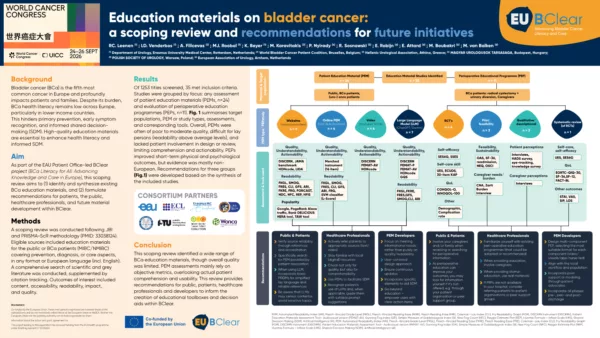
Alex presented the poster Education materials on bladder cancer: a scoping review and recommendations for future initiatives in the session Epidemiology in Action: Populations and Partners. The Congress is organised by the Union for International Cancer Control (UICC) together with the Hong Kong Anti-Cancer Society.
This scoping review is a BCLEAR project deliverable, carried out by the Department of Urology at Erasmus University Medical Center (Erasmus MC) in Rotterdam.
Background
Bladder cancer is the fifth most common cancer in Europe, yet knowledge about the disease remains low, especially in lower-income countries. When people do not have clear information, it is harder to prevent bladder cancer, to recognise early warning signs, and to take part in decisions about treatment.
Good education materials can help with all three. That is why the Erasmus MC team set out to answer a simple question: what bladder cancer information already exists, and is it good enough?
About the study
As part of their work in BCLEAR, the Erasmus MC team, carried out a scoping review. This is a type of study that maps all the available research on a topic. The team searched scientific articles and other published sources in any European language.
Out of 1,253 titles checked, 35 studies were included. They covered two main areas:
- Patient education materials (24 studies): websites, online materials and booklets, videos on YouTube and TikTok, and answers from AI chatbots such as ChatGPT and Gemini.
- Education programmes around surgery (11 studies): programmes for people having their bladder removed (radical cystectomy with urinary diversion), and for their carers.
Key findings
- Many patient education materials were of poor to moderate quality.
- They were often written at a level too difficult for people without a medical background.
- Patients were rarely involved in designing or reviewing them, which makes the materials harder to understand and use.
- Education programmes around surgery helped people recover, with short-term physical and emotional benefits. However, most of this evidence comes from outside Europe.
- Most studies measured materials with reading scores and checklists, but few checked whether patients actually understood them or could put them to use.
Bladder cancer health literacy is low, and lowest in lower-income countries. It makes prevention harder, it makes it harder to spot symptoms early, and it leaves people out of decisions about their own treatment. Good education materials can help with all three.
Recommendations
Based on the findings, the Erasmus MC team set out practical recommendations for three groups.
Patients and the public
- Check where your information comes from, looking for references and accreditation.
- Look for materials from patient organisations.
- If you use an AI chatbot, ask it for plain language and reliable references, and be aware it may avoid some sensitive topics.
- Involve your family or carers when looking for information about surgery. If your hospital does not offer an education programme, your patient organisation or a peer support group can help.
Healthcare professionals
- Point patients to reliable written and video sources, and stay familiar with local and digital resources.
- Check that materials are easy to understand, not only that they are high quality.
- Use education materials to support shared decision-making.
- If your patients use AI chatbots, help them with suggestions for good questions to ask.
- Involve carers in education, and use real materials when teaching patients about living with a stoma (an opening on the tummy through which urine leaves the body).
People who create education materials
- Focus on what people actually need to know, not only on reading scores.
- Design materials together with the people who will use them, and keep them up to date.
- Include clear action points and tools that support shared decision-making.
- Cover every stage of care, from before surgery to after leaving hospital, and include peer support from patient advocates.
Looking to the future
The findings from Erasmus MC's review are now guiding the next stage of BCLEAR: the development of education toolboxes and decision aids for people affected by bladder cancer across Europe. The work was also presented at the European Association of Urology Congress 2026 earlier this year.
By building on what works, and learning from what is missing, BCLEAR aims to make sure that people affected by bladder cancer have the clear, reliable information they need.